Congratulations! Whether it comes from a part-time job, internship, freelance work, or your first full-time role, receiving your first salary is an exciting milestone. After all, earning your own income means greater independence.
A typical fresh graduate salary in Malaysia ranges from RM2,500 to RM4,000 per month. For students or young people working part-time, earnings may range from RM500 to RM1,500 per month, depending on the number of hours worked and the type of job.
At first glance, these amounts may seem like a lot of money, especially if it is your first time earning an income. However, understanding how your salary works can help you manage your money more effectively.
Gross Pay vs Net Pay
Your gross pay is the total amount your employer pays you before any deductions are made. Depending on your employment terms, this can include overtime pay, commissions, bonuses, and allowances. Meanwhile, net pay is the amount you take home after things such as EPF, SOCSO, EIS, and income tax (where applicable) have been deducted from your salary.
Understanding the difference between gross pay and net pay is important when budgeting and managing your finances, as your net pay reflects the actual amount available for spending, saving, and other financial commitments.
So, where exactly does the difference between your gross pay and net pay go? Let’s take a closer look at the common deductions you’ll find on your payslip.
1. Employee Provident Fund (EPF)
EPF is Malaysia’s mandatory retirement savings scheme where a portion of your salary is set aside each month to help you build long-term savings for your retirement.
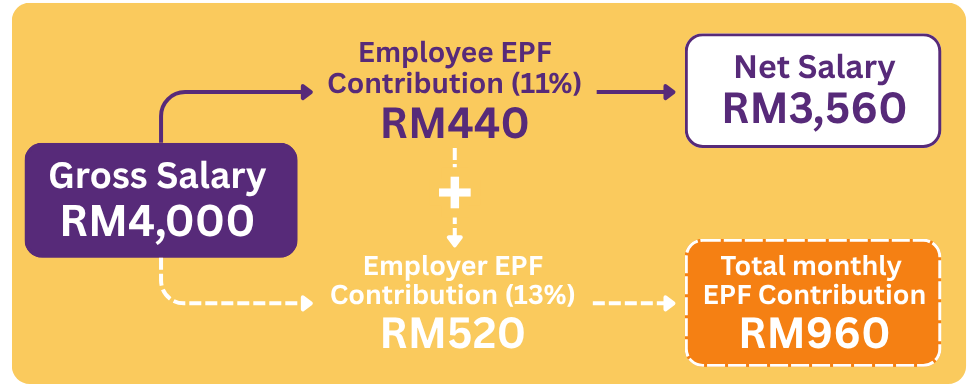
Here’s an example of the breakdown of EPF contributions for a monthly salary of RM4,000, based on the standard contribution rates of 11% for employees and 13% for employers:
–
Beyond retirement, EPF savings can also be used to help with purchasing a home or financing higher education, helping you achieve important life milestones along the way.
To help balance long-term savings with more immediate needs, EPF contributions are divided into three different accounts:
| Account 1: Akaun Persaraan |
75% of your EPF Contribution | Primarily for retirement savings. Funds in this account are generally locked in and can only be withdrawn when you reach the eligible withdrawal age of 55. |
| Account 2: Akaun Sejahtera |
15% of your EPF Contribution | Designed to support important life goals such as purchasing a home, financing higher education, healthcare expenses, and performing Hajj. |
| Account 3: Akaun Fleksibel |
10% of your EPF Contribution | Flexible savings that can be withdrawn when needed. |
2. Social Security Organisation (SOCSO)
SOCSO is a social protection scheme that provides financial assistance and support if you are unable to work due to injury, disability, illness, or other unforeseen circumstances.
Unlike EPF, SOCSO is not a savings account. The money contributed does not accumulate in your name. Instead, it funds a protection scheme that provides assistance when employees face unexpected situations.
Why Should You Care About SOCSO?
Imagine you’re riding your motorcycle to work and are involved in an accident that leaves you unable to work for several months. Without income, paying for daily expenses, medical treatment, and rehabilitation can quickly become a challenge.
This is where SOCSO comes in. Depending on your situation, SOCSO may provide:
- Medical treatment and rehabilitation support
- Temporary disability benefits
- Permanent disability benefits
- Invalidity benefits
- Dependants’ benefits for eligible family members
Previously, SOCSO mainly covered accidents that happened at work or while travelling to and from work. With the introduction of the LINDUNG 24 JAM scheme, SOCSO now provides 24-hour protection, which may also cover accidents that happen outside of working hours.
3. Employment Insurance System (EIS)
While SOCSO protects you against accidents, disabilities, and certain illnesses, the EIS provides support if you lose your job through no fault of your own. For example, if your company undergoes restructuring and your position is made redundant.
Losing your job can be stressful, especially when you still have bills and daily expenses to manage. This is where EIS can help by providing support such as:
- Temporary financial assistance
- Job matching services
- Career counselling
- Skills training programmes
If you meet the eligibility requirements, you can apply for SOCSO and EIS benefits through PERKESO’s online services portal. Supporting documents, such as your termination letter and employment details, may be required during the application process.
4. Income Tax (MTD)
Monthly Tax Deduction (MTD), is a system where employers deduct income tax from your salary on behalf of the Inland Revenue Board (LHDN). Think of income tax as your contribution towards public services such as healthcare, education, infrastructure, and public facilities that benefit all Malaysians.
The amount of tax you pay depends on your income level, tax reliefs, and other factors. Malaysia uses a progressive tax system, which means people with higher incomes generally pay a higher tax rate than those earning less.
As a fresh graduate, you may not need to pay much or any tax at all, depending on your income level. However, understanding how taxes work early on will help you manage your finances better as your career progresses. To learn more about taxes, you can visit the LHDN portal or refer to this guide on estimating tax based on your salary!
5. Allowances & Benefits-in-Kind (BIK)
Besides your basic salary, many employers offer additional allowances and benefits such as travel allowance, meal allowance, bonuses, medical coverage, and flexible working arrangements as part of your overall compensation package. These are designed to help cover work-related expenses, improve employee wellbeing, and make your employment package more attractive.
It’s important to note that not all allowances and benefits are treated the same way. Some may be subject to EPF, SOCSO, EIS, or tax deductions, while others may not. The treatment depends on the type of allowance or benefit provided.
When evaluating a job offer, take the time to look beyond the basic salary. Understanding the full compensation package can give you a clearer picture of the actual value your employer is offering.
All the best!
Now that you understand how to read your payslip, you’re better equipped to make sense of where your money goes. Remember, earning your first salary is exciting—but learning how to budget and make informed financial decisions is what sets you up for long-term financial success.